
Budget Breakdown: Myths vs. Facts
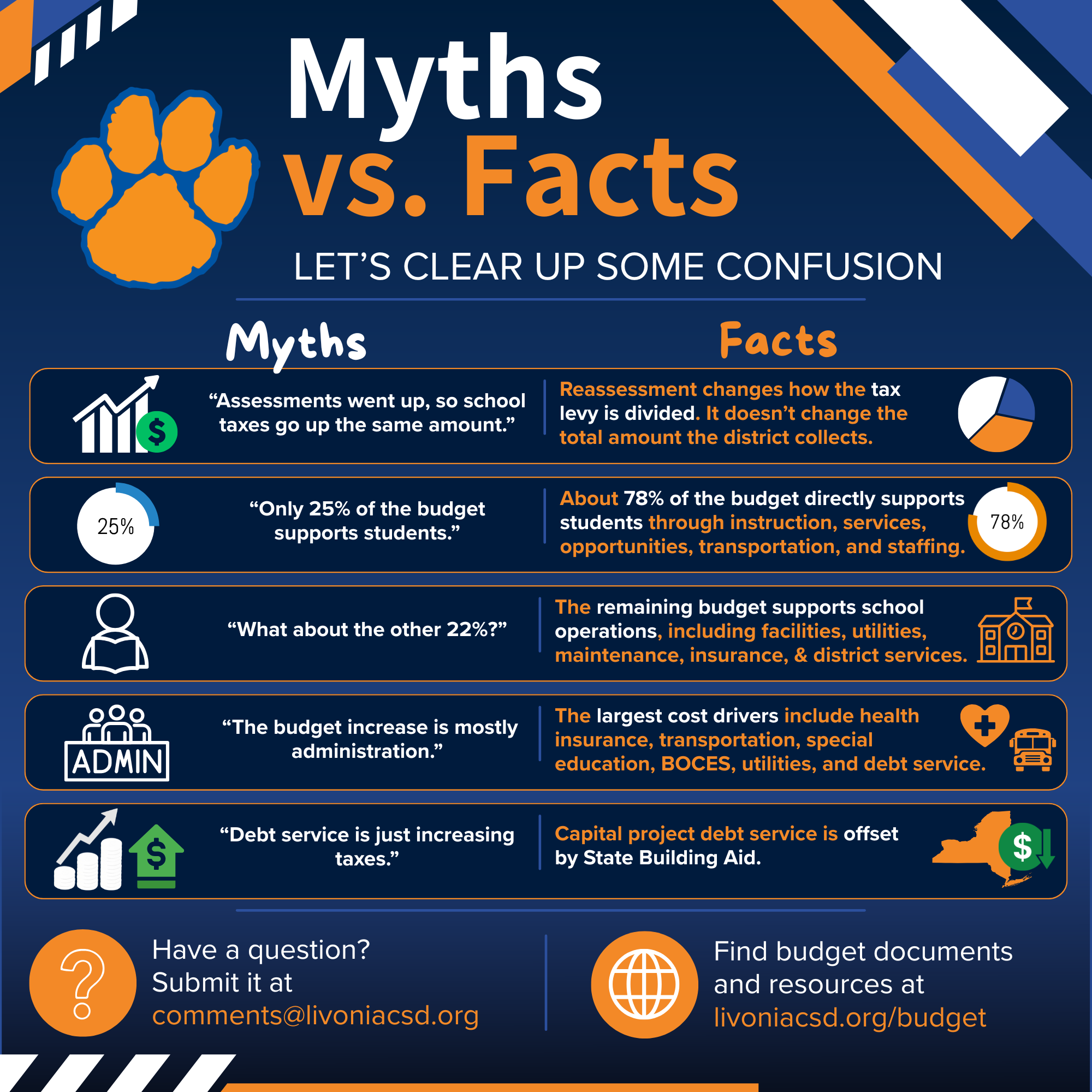
Today’s Budget Breakdown focuses on a few common questions and concerns we have heard about the proposed 2026–27 budget.
Misconception: “Assessments went up, so school taxes go up the same amount.”
Reality: Reassessment changes how the tax levy is divided among properties. It does not change the total amount the district collects. The Board of Education controls the tax levy, which is the size of the pie. Assessments, equalization rates, exemptions, and final assessment rolls affect how that pie is divided.
Misconception: “Only 25% of the budget supports students.”
Reality: Student support is more than one budget line. Teaching & Learning is one important category, but students are also supported through special education, counseling, health services, libraries, technology, transportation, athletics, clubs, music, art, and the staff who provide those services. When those areas are included, about 78% of the proposed budget supports teaching, learning, student services, student opportunities, transportation, and the staff who serve students.
Misconception: “What about the other 22%?”
Reality: The remaining portion of the budget supports the operations that make school possible, including buildings, utilities, maintenance, insurance, debt service, and districtwide operations. These costs keep schools open, safe, clean, heated, insured, maintained, and ready for students and the community.
Misconception: “The budget increase is mostly administration.”
Reality: The largest cost drivers are health insurance, utilities, insurance, transportation, special education, BOCES programs and services, and voter-approved debt service. In fact, the District has reduced 17% of its administrative staff in the last three years, and total salaries allocated to administration have declined 13% since 2023–24.
Misconception: “Debt service is just increasing taxes.”
Reality: The increase in debt service is connected to the voter-approved capital project. That cost is offset by increased State Building Aid. This is why the total budget can increase while the local share is protected.
More detailed answers are available in the Budget FAQ at www.livoniacsd.org/budgetfaq
Learn more at www.livoniacsd.org/budget
Have a question? Email comments@livoniacsd.org